No Knife Soup
How to Cook Well When You Are a Dirtbag With Seven Dull Knives

You’re really not supposed to have a dull knife. Least of all if you’re supposed to be a restaurant chef of any kind of supposed skill. Having a dull knife in a kitchen is sort of like arriving to an office job with that bird scribe guy from “The Flintstones” instead of a computer. You can kind of do your job, but it’s going to take a lot longer, and the work is going to look pretty rudimentary. There are chefs out there who dedicate a lot of their free time to sharpening their knives in order to stay on top of their game, and there are chefs who outsource the task. There are chefs of the former variety who pass judgment on the latter. One of my friends once told me about a prep cook he used to work with who would just buy a new cheap knife every week instead of investing in a blade that he’d have to maintain. Regardless of one’s approach, it is really not the thing to do to show up to work with a dull edge.
But I had a lot of dull knives this past week. And if you’re a home cook reading this, I am sure you have your share of dull knives, too. Maybe, like me, you’ve been running around doing a bunch of other shit you’re responsible for, or, also like me, you felt you deserved a break and went mini golfing instead. Maybe you, too, considered the cooking you’d need to do this week but then got drunk and ate one too many mushrooms and had scary dreams and then rinsed and repeated the day after that. Maybe you also had a lot of laundry to fold and emails to answer and phone calls to make and menus to write and meetings to have and deadlines to make and doors to open and balloons to inflate and this and that and these and those. Maybe the weeds had consumed you, say.
Maybe you considered the ease with which you could potentially slice through an onion if you would just sharpen the thing but what you did instead was nothing. Maybe you hit the honing steel again and again and again to no major avail. Maybe you bruised the parsley. Maybe the garlic chives laughed in your face.
I am not a very big fan of the trend toward effortless everything. I appreciate very much the idea that folks in the modern world are more overworked than ever and have less time to cook or do other life tasks–and that trying to incorporate cooking in a less burdensome way is a good thing. But I do think there is a difference between thoughtlessness and ease. More specifically, I believe it is important to wrestle with recipes of various levels of complexity or involvement in order to cook well and live well. To always approach cooking at the point of least friction (forgive me) is to miss out on the practice of attention and care. That being said, we all hit the wall sometimes or go through periods in which our capacity is lower than usual. For me, this week, until I sort of grabbed my pigtails, screaming, and phoned a very skilled knife sharpening friend for help, I could hardly claim to own a knife, other than one flamboyant refurbished scimitar that has little business getting involved with basic prep.
I do believe we can still make great food with abundant attention when we are limited and stretched and in the weeds; however, I think we need to let our limitations guide us rather than trying to produce the same dishes with our hands tied behind our backs. Or, in this case, with no knives. I have no issue with the heavenly mandate, “store-bought is fine.” It applies to a lot of things, and it removes the guilt from cooking while busy. But I am also here to offer that homemade is fine–and can be profound in its simplicity.
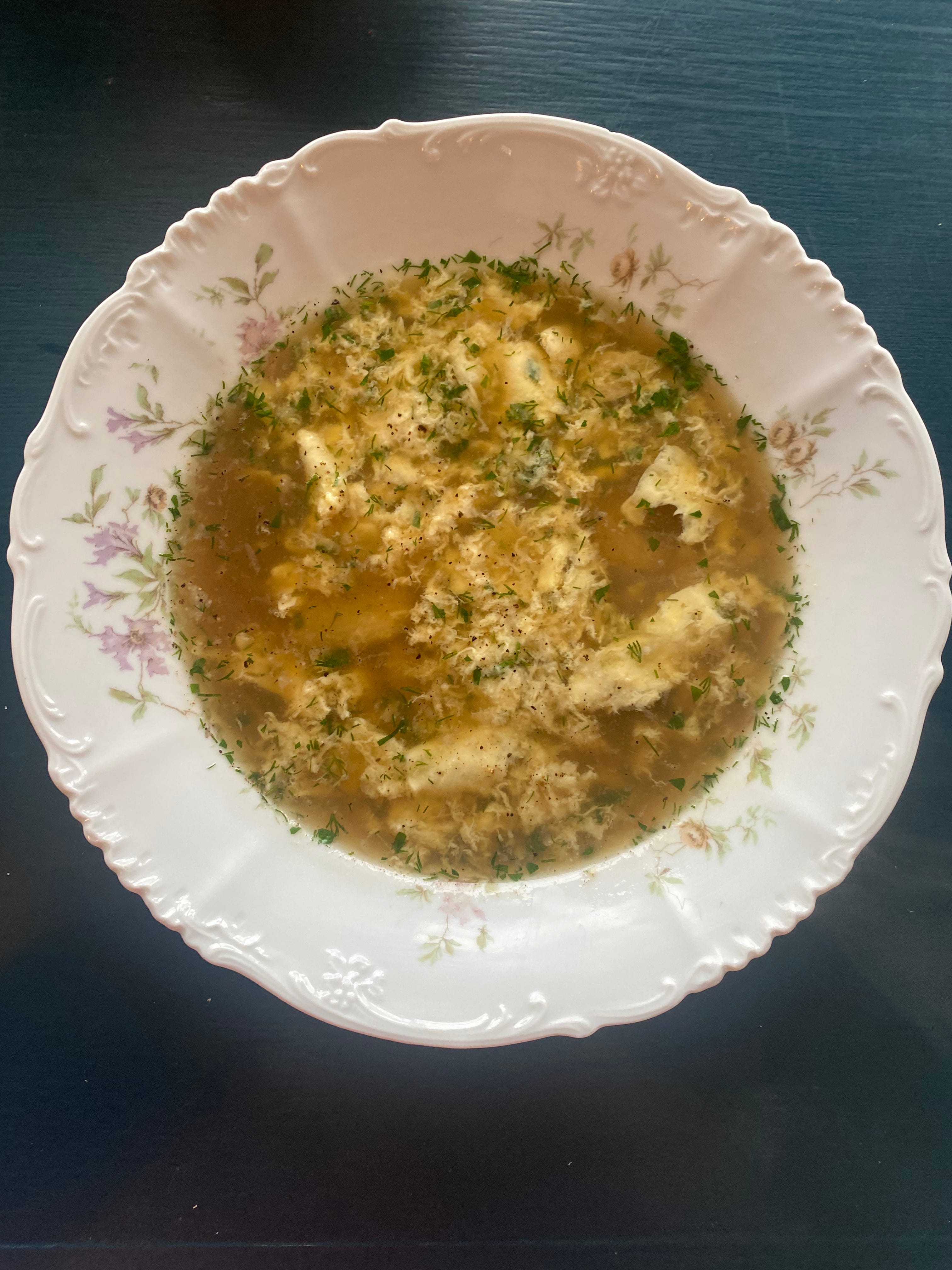
This week, we served a soup that required only one dull pairing knife in its execution–and better that it be dull for the task of garlic peeling so as to preserve one’s thumb. While it required the least knife work of any soup we’ve served in recent months, this one probably received the highest praise. And that may be due to its appropriately simple, soothing nature at a rainy and soft time of year–but perhaps, also, it was because the soup was so plain that it required as much attention as we could afford to give it.
Most everyone is familiar with egg drop soup in one form or another–it’s a soup that presents differently across various cuisines. But the basics are the same: drop some beaten egg in hot broth, simmer briefly, and call it a day. Beyond that, there are myriad additions to make or whims to follow in its preparation.
The leading lady of our soup this week was whole garlic cloves. I have to admit that over the last five years, as I’ve become progressively more weeded by the week, I have often chosen to skip the step of chopping garlic for soups and stews altogether. I run into the kitchen, start in on a cup of coffee, dump a bucket of congealed pork stock into a pot, and chase it with a quart of [freshly] peeled garlic (miss me with that pre-peeled stuff–sorry ‘bout it). Even if we haven’t gotten to peeling the day before, it’s not that hard to quickly denude a few heads. But there has been nary a more liberating feeling than kerplunking an entire quart of garlic cloves into a pot and just letting it rip. Such has become my custom.
Sure, some will argue that the cloves break down into the cooking liquid and that it doesn’t matter either way. But not me. I like it when I see the garlic cloves bobbing in the soup. It makes me feel like I’m serving medicine. The velvety texture of a boiled garlic clove is not something we get to have enough. Maybe I’m clawing at the nostalgia of having grown up in the nineties, when everyone was jizzing themselves about serving a whole head of roasted garlic. Maybe I’ve got my mind on vampires, as our work in hospitality is predicated on inviting people in the door. I don’t know.
What I do know is that my knifeless soup owes almost its entire character to the overabundance of whole, boiled garlic cloves. And a little bit to the inclusions of egg, herbs, cheese, and pepper. And a lot a bit to the attention we pay the seasoning, which is always important but even more so when hardly anything is going on in the bowl in question.
No Knife Soup
This is not a recipe but rather a method, because you can do a lot with no sharp at all. The one thing you maybe can’t do is not hate yourself just a little.
Stock: even Ina says you should make your own. If it helps you at all, we often only use bones and a paltry amount of vegetable or herb scrap in ours. If you don’t have mirepoix shenanigans, you’re just fine in my book.
Aromatics/additions: obviously, I am stanning whole cloves of garlic, who need hardly hold the hand of another scented vegetable or root. But other shit that’s good is pretty much anything. A knob of ginger, some cabbage leaves, some small onions, a cheese rind, a mushroom or three…this is where you take a hard look at your life and see what can be torn into the broth. I think it’s best to choose items that will get soft or be easy to fish out if they’re only going in to infuse.
Egg: beat up some eggs! You can add other seasonings of your choice, but I don’t (other than salt)
.
Finishing things: fresh torn herbs go a long way in a cozy broth. We use parsley and dill, but you can do whatever you want. Cheese on top is optional but transcendent–you can either use a hard cheese for intense flavor or a soft, gooey cheese (but I think soft cheese is sort of even better when you throw in some stale bread first). Pepper? I am one of these annoying people who doesn’t understand the ubiquitous nature of black pepper in food, but I do happen to think it adds life to very garlicky and very simple broth. Especially hardens my bones during this rainy season we’re in.
Mostly, this is a soup of tasting and adjusting and using your intuition. The only true guidance I would offer is that the texture of the egg drop depends on the level of boiling happening in your soup when you add in the egg. A hard boil will yield a sort of wild, puffy, souffléd consistency, while you will get very milky, subtle curds if the soup is not simmering at all when you drop egg. I like to go for a confident simmer–and then I reduce the heat when the wispy curds appear.
If you also have no knives but wish to eat something soulful and good during these chilly, green, rainy, spring days, I would recommend making yourself a batch of broth, grabbing a dozen good eggs, and having this method in your back pocket for gratifying and impressive breakfasts, lunches, and dinners. To yield to your capacity can be a source of inspiration rather than source of stress. Maybe next week, you or someone else will tend to your neglected utensils. But for now, soup.
Once again you peel back the layers of this business and beauty in the reality that we can’t always be on top even though we try
I personally think the sharp knife obsession is a byproduct of the masculine obsession with war and weapons. Also would NEVER purchase pre-peeled garlic, and highly recommend "The Book of Garlic" by Lloyd K. Harris (which also happens to be required reading for any Chez Panisse heads). Bless the weeds!